
We've Got Parity?
Supercars and the never ending parity debate.

Supercars, after 10 days in a wind tunnel, have declared all three cars have achieved “parity”. The Chevrolet Camaro, the Ford Mustang, and the new Toyota Supra are all within the “parity box”.
But first, what is parity?
Supercars have had a long and storied history with parity. Since the category became truly a “spec series” in 2013 with the Car of the Future regulations, each manufacturer’s car designs and builds have been carefully controlled as to not have one car have significantly better performance than another. This means some parts are controlled through the series and a process called homologation. Each manufacturer has a homologation team which is in charge of developing the car and ensuring all new parts are compliant and have gone through due process before being released into competition circulation. For 2026, the homologation teams are Triple Eight Race Engineering/Red Bull Ampol Racing (Ford, previously Chevrolet), Team 18 (Chevrolet), and TWG Walkinshaw Racing (Toyota). Ford’s previous homologation team was Dick Johnson Racing/Shell V-Power Racing.
Parity has been a long running debate within the Supercars paddock and fan base, starting in the Gen2 era. More recently with the update to Gen3, there’s been a lot of focus on the Ford Mustang’s performance. In 2025, Dick Johnson Racing came forward with a report, arguing that the Mustang was at a significant disadvantage with the increase altitude at Mount Panorama due to how the lower air density impacts the engine performance. The report itself had ambiguous wording that effectively stated more testing was required for scientific reliability. Other teams and drivers did note that is was much easier to overtake the Mustang if the other driver was in a Chevrolet and had drafted up to near the rear of the Mustang, indicating a deficit in aerodynamic performance, but this is anecdotal and not been robustly tested.
Why should we care?
Parity in theory means all the cars have an equal opportunity to win each race, that one manufacturer isn’t more suited to one location than another. Fans and the series should want parity to promote a good racing product. Dick Johnson Racing’s outcry about Bathurst, to the point where driver Brodie Kostecki was quoted with “we can’t win Bathurst because we’re in a Ford”, even though a Ford did win the Bathurst 1000 in 2025 with Matt Payne and Garth Tander in Penrite Racing’s Ford Mustang, if it were true would indicate a one-sided “Camaro Cup” which is a poor racing product which would bore fans.
We’ve seen some tracks become “Camaro Cups” or lean towards the Ford, typically Tasmania becomes a Camaro dominated affair. However, I would be interested in how much the teams and their set up of the car is the cause versus a baseline disparity between manufacturers. Triple Eight/Red Bull have been the dominant teams force over the Gen3 era, and with the change from Camaro to Mustang could expose whether it is the Camaro helping them to wins over the rest of the field. I’m inclined to say no, as the next three teams are all Ford teams. It’ll be good to hopefully put the parity discussion to bed for a while, as a lot of it becomes either to gain an advantage in the paddock or a Facebook keyboard warrior’s favourite topic to cry about online.
In 2025, Chevrolet won 17 races and Ford 16, resulting in the closest manufacturer battle for a while. Supercars has touted this as a result of extra homologation testing that started at the end of 2023 with the aim of increasing the parity between the Camaro and Mustang.
So what now?
With the new Toyota Supra joining the category, Supercars decided to take the three cars to the wind tunnel in the US to attempt aerodynamic parity in late 2025. Additional testing also was done to attempt engine power parity. Supercars deemed the three cars to be within the “parity box” for aerodynamic performance, indicating the three cars aren’t the same, as can be expected between three different designs, especially the Supra which looks very different from the other two cars. The parity box is a threshold within which Supercars has deemed that the cars are close enough to each other to be acceptable.
Supercars has noted that the Ford Mustang and Toyota Supra were closely aligned on front ride height sensitivity, with the Mustang having “peakier” sensitivity compared to the Camaro. The Camaro was found to have more “forward aero balance” with less front ride height sensitivity. Front ride height sensitivity correlates to how much downforce is available when the car floor is different distances from the ground. The Mustang reportedly has more front downforce at a low ride height, which reduces as height is increased which is inverse to what was found with the Camaro.
Supercars has reported that minor aerodynamic changes were applied to both the Mustang and Camaro due to these sensitivities, and that the Supra has been homologated. Homologation took place with a wing angle of 10 degrees.
The Camaro will receive a partial redesign to the front undertray skid block and a new undertray infill. Whereas the Mustang will have the spoiler adjusted to a lower height, the side skirt leading edge packer reinstated, and read wing angle increased to that 10 degree homologation mark.
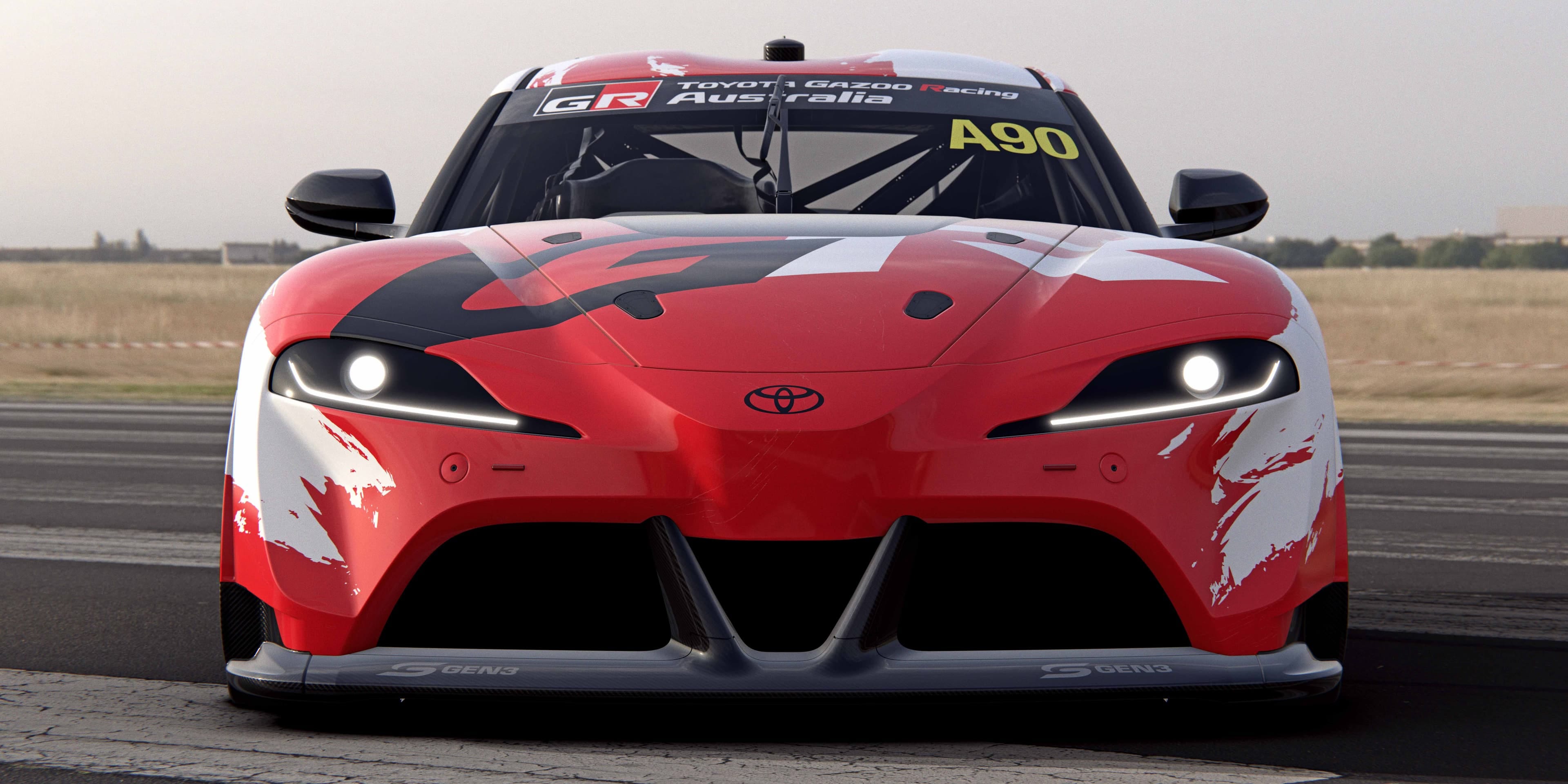
The Supra reportedly has undergone “subtle tweaks”, which is vague enough to be anything really. We have now seen the new model of the Supra which is homologated, whereas the model which ran demonstration laps late last year is different enough to mention in the Supercars article. Speedcafe reported that the front of the Supra will look significantly different to what we’ve seen previously.
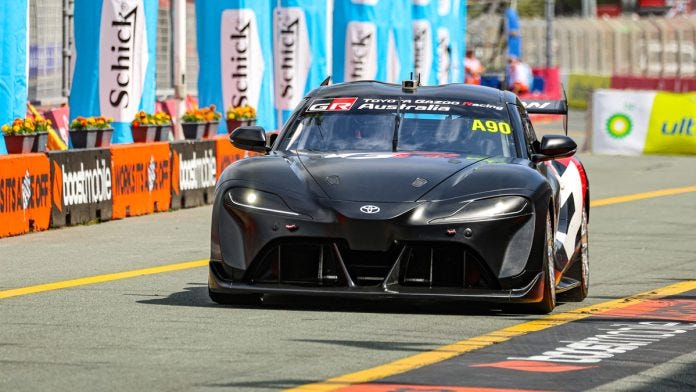
Top: Toyota Supra on track at Gold Coast 2025 (credit: Mark Walker via V8 Sleuth)
Bottom: digital render of aero-homologated Toyota Supra (via Supercars)
I do find it interesting that Brodie Kostecki was able to attend the wind tunnel testing, despite his team, Shell V-Power Racing, no longer being a homologation team, and that he was the only driver in attendance. He has claimed on his podcast “Lucky Dogs” that the Toyota engine is “quite far behind”, but the “car turned out well aero-wise and stuff”, despite qualifying his information was received “third-hand”. Perhaps he was having a snoop around to see what the cars are looking like after the Ford homologation handover debacle between his team and Triple Eight Race Engineering last year, or just trying to see if he can make excuses for not winning Bathurst for 2026.
Additionally, Supercars is reportedly introducing a lap time threshold trigger, where if there is a significant difference between the cars’ lap times across the first six races relative to each other, a review will be triggered and changes made to the cars to increase parity. This change is still to be signed off by the teams.
The first full-field test day will be on the 18th of February at Sydney Motorsport Park, with media coverage and live timing only. The test day will not have general public access due to venue operational requirements.
The Repco Supercars Championship for 2026 will be back on track with Race 1 on February 20, 2026 at Sydney Motorsport Park.